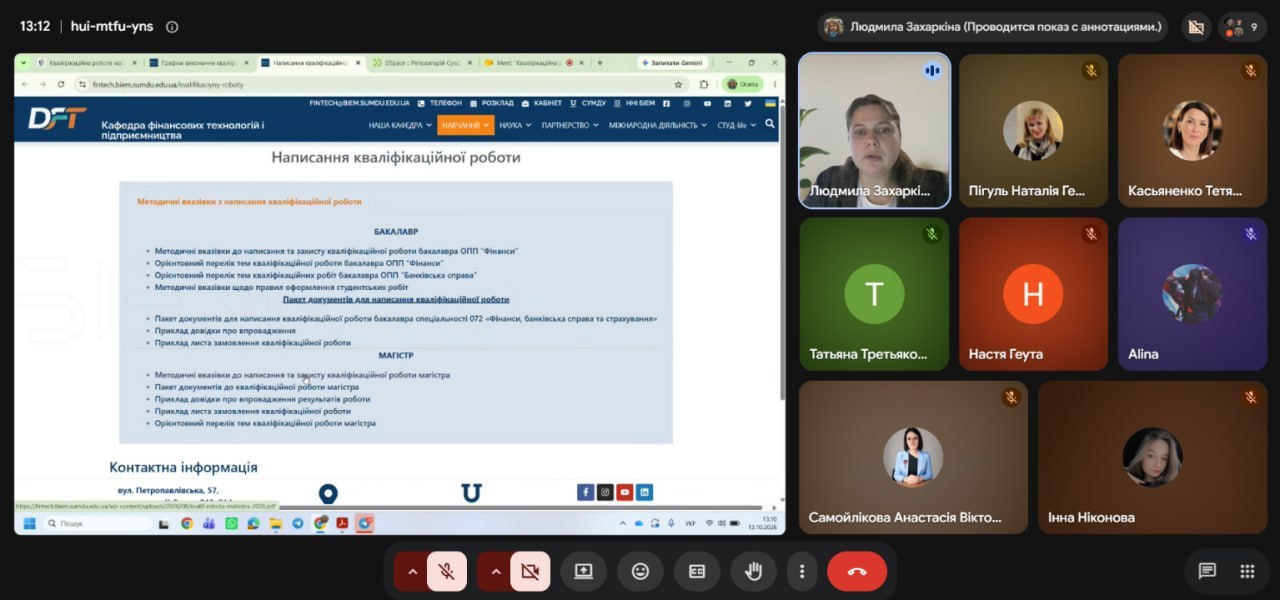
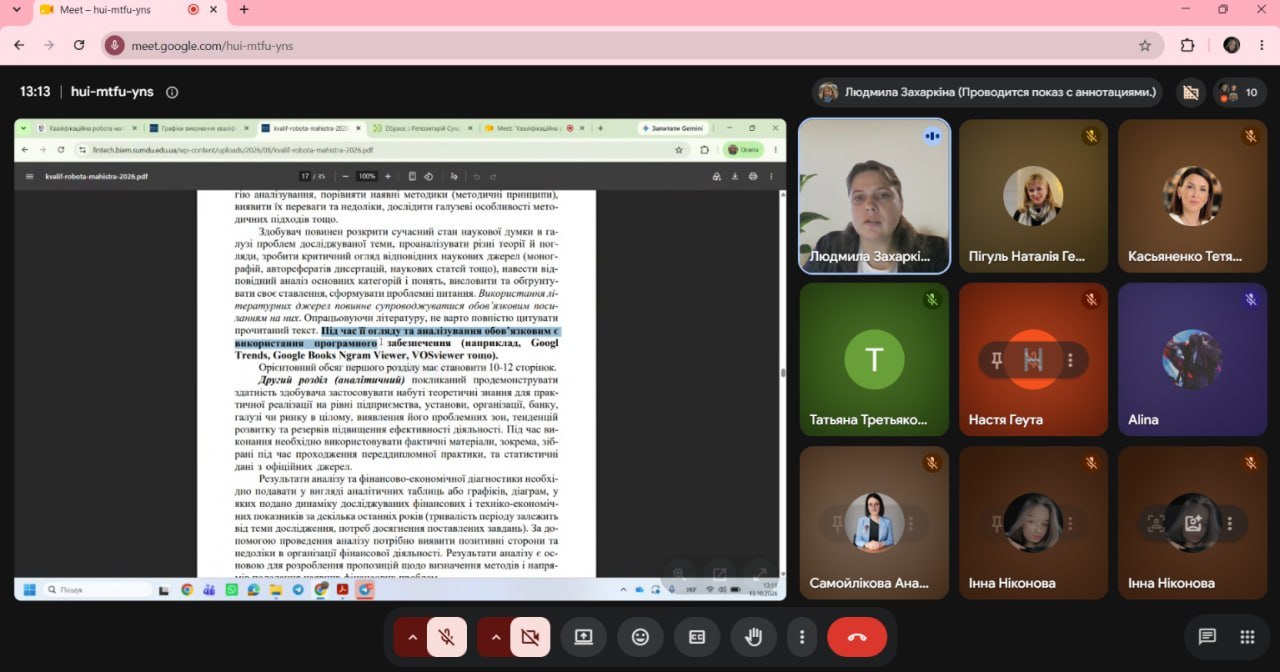
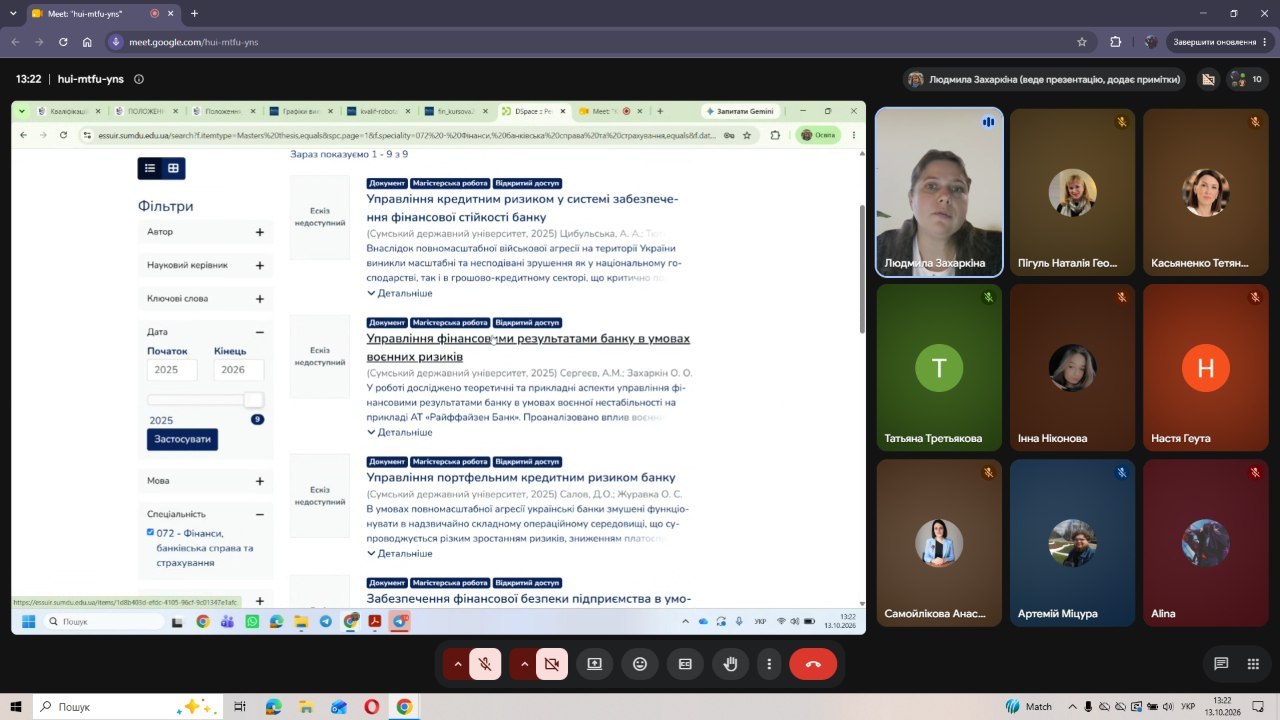
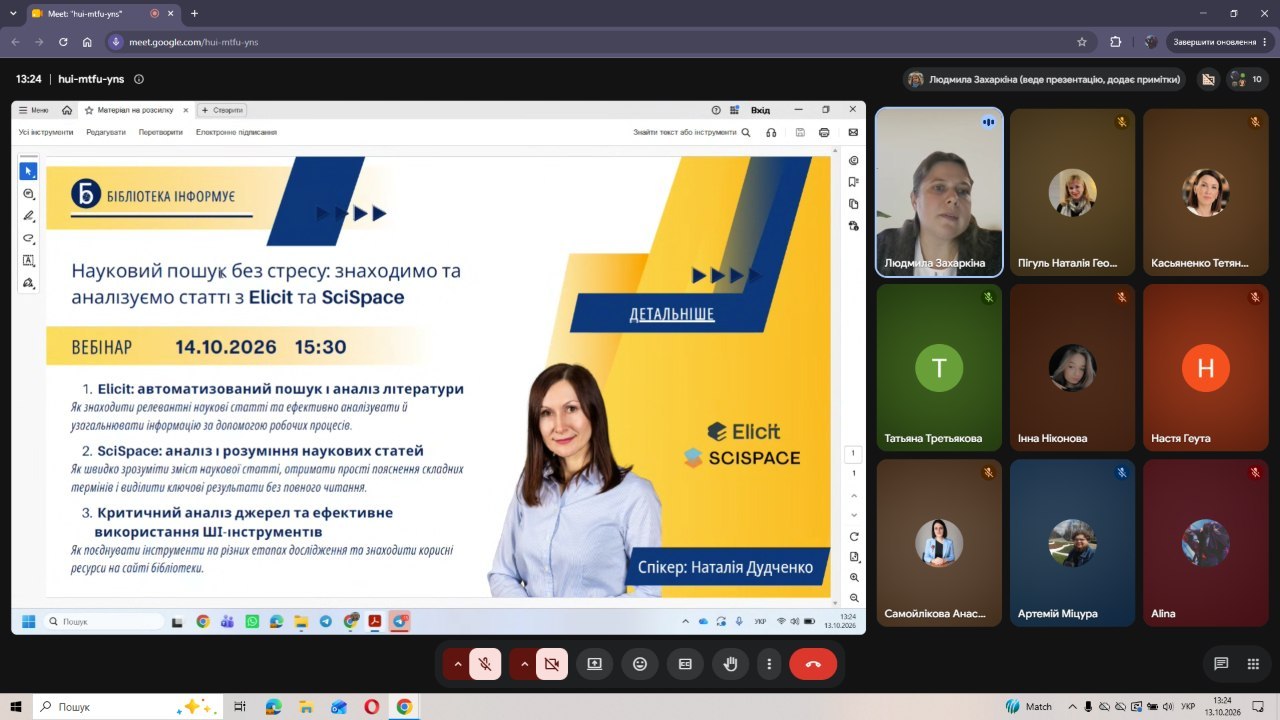
On 13 October 2026, an online meeting was held with second-year students of the Finance master’s programme at Sumy State University (SSU), speciality D2 “Finance, Banking, Insurance and Stock Market”. Participants included students from groups Ф.м-51 and ФС.мз-51с, studying full-time and part-time. The meeting was moderated by the programme guarantor, Associate Professor Liudmyla Zakharkina. Academic staff involved in delivering the programme also joined the discussion.
In the first part of the meeting, participants discussed how to plan their master’s research: agree on the final topic with their supervisor, follow the work schedule and prepare their thesis for defence. They reviewed the requirements for formatting and submitting master’s theses and were reminded where to find methodological guidance, document templates and useful resources in the course on the MIX platform.
Particular attention was paid to academic integrity. Participants were introduced to the updated Regulations on Academic Integrity at SSU and the revised Methodological Instructions for Checking Written Work for Signs of Academic Plagiarism. The discussion covered proper citation and referencing, independent research, responsible use of artificial intelligence tools and careful interpretation of plagiarism check results.
Participants also discussed in detail the updated procedure for making master’s theses publicly available before their defence, the requirements for electronic versions and the use of qualified electronic signatures (QES).
During the overview of the SSU Library’s electronic catalogue and SSU’s institutional repository (eSSUIR), participants revisited the options for finding academic texts that could support their own research. They were also reminded of the support available through the library’s resources on academic writing and data analysis and visualisation. Participants were informed about upcoming library events, including the webinar “Stress-Free Literature Search: Finding and Analysing Articles with Elicit and SciSpace”, scheduled for 14 October. They also explored opportunities to present their research findings at the International Scientific and Practical Conference “Problems and Prospects for the Development of Ukraine’s Financial and Credit System”, organised by the Department of Financial Technologies and Entrepreneurship.
The second part of the meeting focused on the study programme and the catalogue of elective courses. Students shared their learning experiences and views on the content and practical value of curriculum components, the organisation of teaching and learning, and opportunities to apply their knowledge and skills in professional practice. For master’s students nearing graduation, a meeting of this kind offers an opportunity to reflect on their educational experience and consider how their preparation aligns with their professional interests and expectations. Their feedback is particularly valuable, as it draws on their experience of completing most of the programme and selecting courses to shape their individual study paths. Such feedback helps the programme working group better understand students’ needs and take them into account when further improving the programme and the catalogue of elective courses.